Estimate the real cost of hiring in Canada – Use our free true cost to hire calculator to determine all employment-related expenses in just a few clicks.
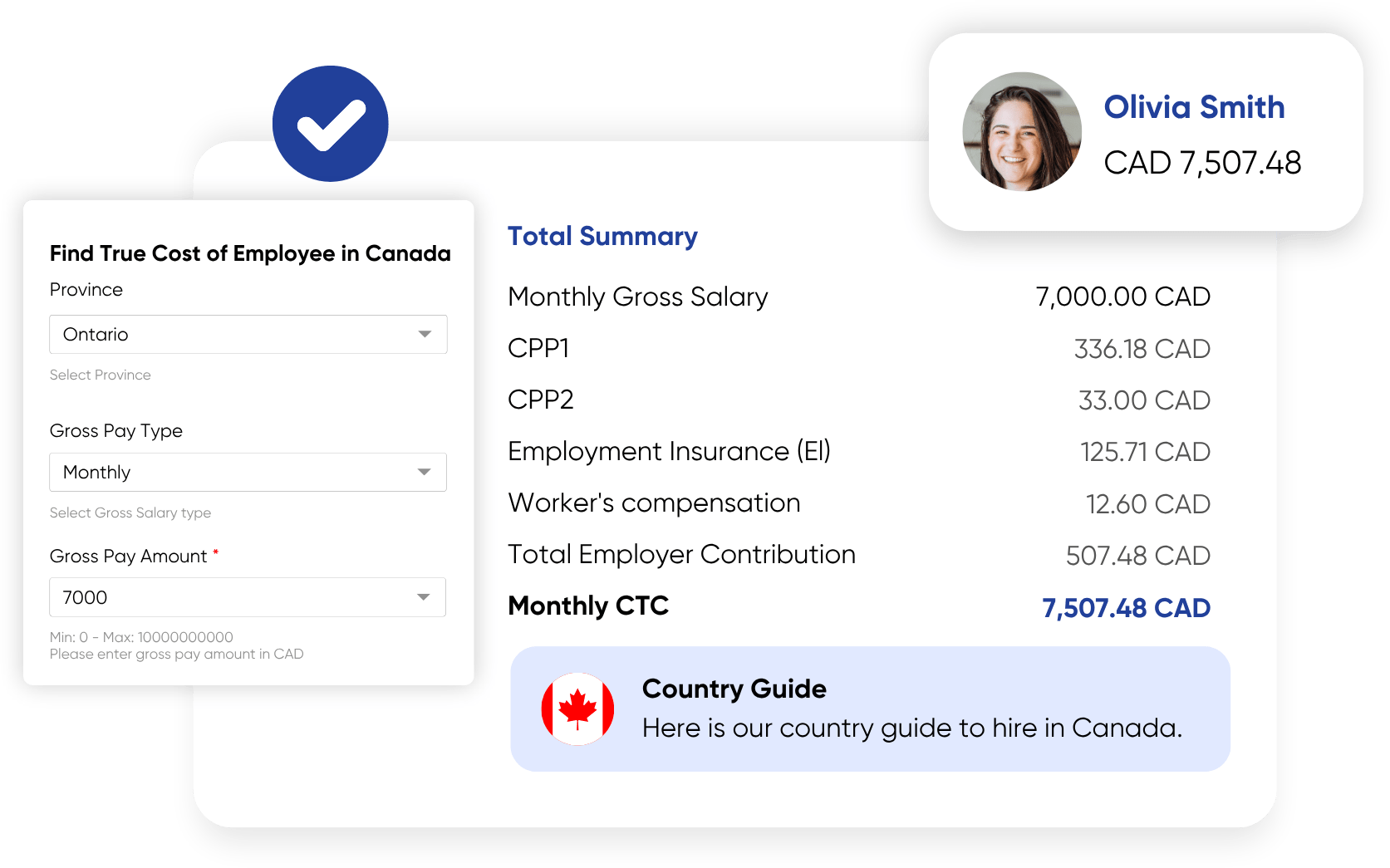
An employee cost calculator for Canada helps employers estimate the true cost of hiring, going well beyond the agreed salary. In Canada, the total employer cost typically exceeds an employee’s gross salary by 10–15%, depending on the province, industry, and payroll size.
Mandatory contributions include the Canada Pension Plan (CPP), Employment Insurance (EI), workers’ compensation premiums, and in some provinces an Employer Health Tax (EHT). Use the calculator below for an instant, province-specific breakdown.
Whether you’re hiring a full-time employee in Ontario or a contractor in British Columbia, this calculator provides a real-time, province-specific cost breakdown based on your selected pay frequency.
Using the Canada Cost Calculator is quick and easy. Follow these steps to get an accurate estimate:
Note: This tool allows real-time estimates monthly or annually. Select your desired cycle and see instant results.
When you hire someone in Canada, the salary you agree to is only part of what you’ll actually pay. Every Canadian employer is legally required to make a set of additional contributions on top of gross wages — collectively known as payroll costs or the employer burden.
Understanding these components is the foundation of any accurate employee cost calculation in Canada. The major statutory employer contributions are:
The employee burden rate in Canada is the total additional cost an employer pays above and beyond an employee’s gross salary, expressed as a percentage. It captures every mandatory payroll contribution – CPP, EI, workers’ compensation, and applicable provincial taxes, rolled into a single number that tells you exactly how much more expensive an employee is than their headline salary suggests.
In Canada, the typical employer burden rate is 10–15% of gross salary, depending on:
|
Cost Factor |
Ontario |
British Columbia |
Quebec |
Alberta |
|---|---|---|---|---|
|
CPP (employer) |
5.95% |
5.95% |
5.95% |
5.95% |
|
EI (employer) |
2.324% |
2.324% |
2.324%* |
2.324% |
|
Workers’ comp (avg) |
~1.2% WSIB |
~1.5% WorkSafeBC |
~1.8% CNESST |
~1.0% WCB AB |
|
Employer Health Tax |
1.95% (>$1M payroll) |
None |
FSS payroll tax applies |
None |
|
QPIP (employer) |
N/A |
N/A |
0.692% |
N/A |
|
Total on-cost above gross |
~12–15% |
~10–12% |
~13–16% |
~10–12% |
*Quebec EI employer rate is reduced (1.881%) because QPIP covers parental benefits separately. Source: Canada Revenue Agency 2026; WSIB Ontario; WorkSafeBC; CNESST Quebec; WCB Alberta.
Worked example: An employee on a $60,000 gross annual salary in Ontario costs an employer approximately $66,600–$69,000 per year in total — a fully loaded burden rate of 11–15%. Use the calculator above to generate a burden rate specific to your province, industry, and salary band.
Are you hiring in Ontario or elsewhere in Canada? Here’s what you need to factor in beyond gross salary:
| Cost Type | Amount (CAD) | % of Gross Salary |
|---|---|---|
| Gross Salary | $5,000 | – |
| CPP Employer Share | $304.35 | ~5.45% |
| EI Employer Share | $126.00 | ~2.3% |
| Workers’ Compensation (WSIB)* | $60 | ~1.2% (industry-based) |
| Employer Health Tax (EHT)** | $97.50 | ~1.95% |
| Total Employer Cost | $5,587.85 | ~11.75% extra |
The total employer cost is the sum of gross salary, employer contributions, and other mandatory expenses.
WSIB rates depend on industry classification. EHT applicable only if total payroll exceeds provincial threshold. Ontario: $1M
Source: Government of Canada (CRA, WSIB), Ontario Ministry of Finance. Updated for 2025.
Beyond statutory costs, Canadian employers may need to cover:
All these items contribute to the overall expense of employing staff in Canada.
| Cost Type | Amount (CAD) | % of Gross Salary |
|---|---|---|
| Gross Monthly Salary | $7,000 | – |
| CPP Employer Share | $304.35 | 4.35% |
| EI Employer Share | $126.00 | 1.8% |
| Workers’ Compensation (IT) | $84 | 1.2% |
| Employer Health Tax (EHT) | $136.50 | 1.95% |
| Total Employer Cost | $7,650.85 | +9.3% |
For international companies — particularly those based in the UK, Europe, India, or the US — hiring a Canadian employee raises an immediate structural question: do you incorporate a Canadian entity, or hire through an Employer of Record?
Both approaches are legally valid. The right answer depends on your headcount, timeline, and risk appetite. Here is how the two paths compare:
|
Factor |
EOR (e.g., PamGro) |
Canadian Entity (Federal or Provincial Corp.) |
|---|---|---|
|
Time to first hire |
3–7 business days |
6–12 weeks (incorporation, CRA registration, payroll account setup) |
|
Setup cost |
$0 — no incorporation required |
$2,000–$8,000 in legal, filing, and professional fees |
|
Monthly compliance cost |
Flat $99/month per employee (PamGro) |
Ongoing bookkeeping, payroll processing, T4 filing, audit — typically $500–$1,500/month for small teams |
|
CPP, EI, WCB compliance |
Fully managed by PamGro |
Your responsibility — requires Canadian payroll expertise |
|
Minimum viable headcount |
1 employee — no minimum |
Economical from 15–20+ employees |
|
Permanent establishment risk |
Low — EOR is the legal employer |
Requires careful tax structuring to manage PE exposure |
|
Best for |
Testing the Canadian market, speed-to-hire, teams under 20 |
Long-term, large committed Canadian teams (20+) |
| Factor | Setting Up a Legal Entity | Using PamGro’s EOR |
|---|---|---|
| Initial Setup Time | 4–6 weeks | 7 Days |
| CRA/WSIB/Provincial Setup | Mandatory | Not Required |
| Payroll and Compliance | Handled internally | 100% managed |
| Legal & Admin Costs | High | Flat service fee |
PamGro’s EOR simplifies Canadian hiring. Just onboard, set salary, and we take care of the rest. Understanding all associated fees, including compulsory and service fees, is essential for accurate budgeting and cost assessment.
Using PamGro’s EOR helps reduce the risk of non-compliance and unexpected costs when hiring in Canada.
Q1. How much does it cost to hire an employee in Canada?
In Canada, total employer cost exceeds gross salary by 10–15%, depending on province and industry. Mandatory contributions include CPP at 5.95%, EI at 2.324%, workers’ compensation (0.2–3.2%), and Employer Health Tax in Ontario (1.95% on payroll above $1M). A $60,000 salary hire in Ontario has a true employer cost of approximately $66,600–$69,000 per year.
Q2. What is the employee burden rate in Canada?
The employee burden rate in Canada is the percentage of additional employer costs above gross salary — including CPP, EI, workers’ compensation premiums, and any applicable provincial health or payroll taxes. The typical Canadian burden rate is 10–15% of gross salary. Rates are higher in Ontario (EHT) and Quebec (QPIP) than in Alberta or British Columbia.
Q3. What is the employer CPP contribution rate in Canada for 2026?
For 2026, employers in Canada match employee CPP contributions at 5.95% of pensionable earnings between the basic exemption ($3,500 annually) and the Year’s Maximum Pensionable Earnings (YMPE). The maximum employer CPP1 contribution per employee is $3,867.50. CPP2 adds up to $188.55 per employee on earnings above the first ceiling. (Source: Canada Revenue Agency, 2026.)
Q4. What is the employer EI rate in Canada for 2026?
The employer Employment Insurance (EI) rate for 2026 is 2.324% of insurable earnings — 1.4 times the employee rate of 1.66%. Maximum annual insurable earnings are $65,700, making the maximum employer EI premium $1,527.27 per employee. Quebec employers pay a reduced rate of 1.881% and contribute separately to QPIP at 0.692%. (Source: Service Canada, 2026.)
Q5. Does an employer have to pay workers’ compensation in Canada?
Yes. Most Canadian employers must register with their provincial workers’ compensation board and pay premiums based on insurable payroll and industry risk class. Rates vary: Ontario (WSIB) averages ~1.2%, BC (WorkSafeBC) ~1.5%, Quebec (CNESST) ~1.8%, Alberta (WCB) ~1.0%. Some industries and self-employed individuals may qualify for exemptions — check with your provincial board.
Q6. What is the Employer Health Tax (EHT) in Ontario?
Ontario’s Employer Health Tax is a provincial payroll tax of 1.95% levied on employers whose total Ontario payroll exceeds $1,000,000 per year. Employers below this threshold are exempt. EHT funds provincial healthcare and is remitted to the Ontario Ministry of Finance, separate from federal CPP and EI obligations. Similar payroll taxes exist in Manitoba and British Columbia.
Q7. What is the difference between gross salary and total employer cost in Canada?
Gross salary is the agreed pre-tax compensation paid to an employee. Total employer cost — the true cost of an employee — is gross salary plus all mandatory employer-side contributions: CPP, EI, workers’ compensation, and applicable provincial health taxes. In Canada, total employer cost is typically 10–15% higher than gross salary. The gap is larger in Ontario and Quebec than in Alberta.
Q8. Can a foreign company hire employees in Canada without a Canadian entity?
Yes. Foreign companies can legally employ Canadian workers without incorporating a Canadian entity by using an Employer of Record (EOR). The EOR becomes the legal employer on record, managing CPP, EI, workers’ compensation, T4 filing, and provincial compliance — while the employee works exclusively for your company. PamGro offers Canada EOR services from $99/month per employee.
Q9. How do I calculate the true cost of an employee in Canada?
To calculate true employee cost in Canada: (1) Start with gross monthly salary. (2) Add employer CPP at 5.95% of pensionable earnings. (3) Add employer EI at 2.324% of insurable wages. (4) Add workers’ compensation premium for your province and industry. (5) Add Employer Health Tax if applicable. Sum these to get your total monthly employer cost — or annualize for full CTC.
Q10. How much does a fully loaded employee cost in Canada?
A fully loaded employee cost in Canada includes gross salary plus all employer statutory contributions. On a $60,000 gross annual salary in Ontario, total fully loaded cost is approximately $66,600–$69,000 — a burden rate of 11–15%. In Quebec, QPIP adds a further 0.692% of insurable wages. Use the calculator above for a precise, province- and industry-specific fully loaded cost estimate.
Manage global hiring, compliance, and payments with a single platform built for clients, contractors.
Ans: Employer costs in Australia typically include:
Ans: Employment tax is calculated based on:
State-based payroll tax varies depending on the employer’s annual payroll threshold and state-specific rates.
Ans: Yes, employers are required to contribute to employees’ superannuation at a minimum rate of 11% of their gross salary (as of 2025). This contribution is mandatory for all employees earning over $450 in a calendar month.
Ans: On average, employers can expect to pay an additional 15%–20% of an employee’s gross salary. This includes superannuation, payroll tax (varies by state), and workers’ compensation insurance.
Ans: No, health insurance is not a mandatory cost for employers. However, many employers offer private health insurance as part of employee benefits packages to attract talent.
Ans: Yes, employment costs may vary depending on the type of contract:
Contractors: Employment costs are generally lower as contractors are responsible for their taxes and superannuation unless deemed an employee under Australian law.
Ans: Yes, the Australian government offers tax incentives, such as:
Ans: Australia’s employment costs are higher compared to many Asian countries but lower than in countries like the United States and some European nations due to its relatively straightforward taxation system and competitive superannuation rates.
Ans: The calculator estimates the total employment costs, including:
Ans: Yes, the true cost of employee calculator provides an estimate of workers’ compensation costs, which vary by industry and state, helping employers plan accordingly.
Ans: Yes, the total employment cost calculator factors in all direct and indirect costs, giving a clear picture of the total cost of employing an individual.
Ans: Small businesses can use the calculator to:
Ans: While the cost per employee calculator doesn’t directly suggest cost-saving measures, it provides transparency into labour cost components. Employers can use this information to optimize benefits, payroll structures, or tax strategies.